ping Up with Timber Movement, Grain, and Manufactured Boards
If there is one major takeaway from my latest class with Marcus, it’s this: wood is alive. Well, not literally alive, but it breathes, moves, and reacts to the environment in ways that can completely ruin a project if you don’t plan for it.
As a Beginner Maker, understanding the physics of your material is just as important as knowing how to handle a chisel. Here is the breakdown of what Marcus taught us about timber behavior, grain direction, and the engineered alternatives.
1. The Waiting Game: Seasoning Timber
Before wood ever makes it to a merchant like B&Q / Wickes, it has to go through a rigorous drying process called seasoning. Freshly cut “green” wood is completely saturated with water. To make it usable, it has to dry out.
- The 1-Year Rule: The general industry standard for air-drying timber is that it takes approximately 1 year per 1 inch of thickness for the wood to season properly after being cut.
- Massive Weight Loss: A staggering 27% of the wood’s volume is lost purely to water evaporation during this process.
- The Target Moisture Content: Air seasoning typically brings the moisture level down to about 12% to 16%, though this varies depending on the timber provider.
- Kiln Drying vs. Air Drying: To speed things up, wood can be placed in giant ovens called kilns. While kiln drying only takes about 6 weeks, it comes with a catch—drying the wood too fast can sometimes make the timber brittle.
2. The Golden Rule of Grain: Long-Cut vs. Cross-Cut
Wood moves, but it doesn’t move equally in all directions. This comes down to the orientation of the wood fibers.
- Long-Cut (Along the Grain): When wood is cut along its length, it will not change in size due to water or atmospheric moisture. The length of your board stays stable.
- Cross-Cut (Across the Grain): This is where the chaos happens. Wood will change shape across its width and thickness depending on moisture levels, and exactly how it deforms depends entirely on where the board was cut from the log.
Differential Shrinkage & The Quest for the Best Cut
Marcus introduced us to the concept of differential shrinkage—the fact that wood shrinks at different rates tangentially (along the growth rings) versus radially (across the rings) and bit longitudinally.
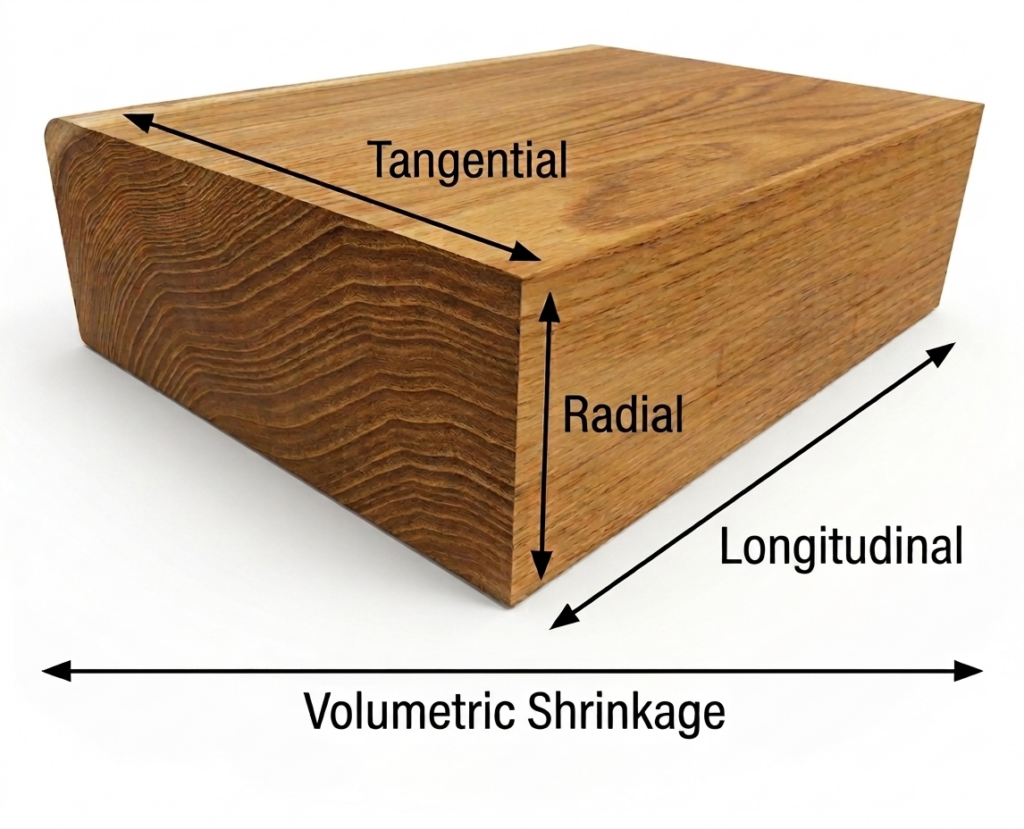
Quarter Sawn / Rift Sawn: These are the best cuts to avoid shrinkage. By cutting the wood perpendicular to the growth rings, the timber remains incredibly stable and shrinks evenly without twisting.
Tangential Cuts (Plain/Flat Sawn): These boards are cut absolute parallel to the rings. They are highly prone to cupping and warping, making them not ideal if you want to avoid structural distortion.
3. The Engineered Alternatives: MDF and Plywood
Because natural timber moves so much, the industry invented manufactured boards. Marcus gave us a great breakdown of the two most common types:
Medium Density Fibreboard (MDF)
MDF is essentially compressed wood fibers glued together.
- The Trade-off: It is relatively low strength, meaning you wouldn’t use it for structural joints or heavy-load shelving.
- The Benefit: Because it has no grain, it is perfectly flat and uniform. This makes it an excellent substrate for veneering (gluing a thin layer of beautiful, expensive hardwood over the top).
Plywood
Plywood is a massive step up in engineering. It is made by gluing together thin sheets of wood veneer.
- The Cross-Grain Trick: The key to plywood’s genius is that the layers are placed with their grains running in opposite directions (alternating 90 degrees).
- The Odd Number Rule: Plywood layers are always assembled in odd numbers (3-ply, 5-ply, 7-ply, etc.). This ensures the grain on the top and bottom faces runs in the exact same direction, keeping the board perfectly balanced so it won’t warp.
- Strength & Beauty: This alternating grain gives plywood fantastic strength in all directions, and just like MDF, it is incredibly stable and great for veneering.
Final Thoughts from my IKEA Workbench
Learning all of this makes me look at the spare pine kitchen table I’m working on in a completely different light. Every tabletop, joint, and shelf requires you to play by the rules of the tree it came from.
Next time I’m marking out a cut, I’ll definitely be checking the growth rings on the end grain to see exactly which way that wood is going to want to move!
A Historical Flex: Think plywood is a modern invention? Think again. Marcus let us know that plywood has been in existence for over 6,500 years, originating all the way back in ancient Egypt!